
Strategic and Operational Platforms for Regional SALW Cooperation
The facilitation of regional cooperation and support for evidence-based policymaking on SALW control has strengthened capacities for the design and implementation of evidence-based SALW control policies, contributed to the standardisation of approaches, and further reduced the threat of the illicit proliferation of SALW through coordinated action at both strategic and operational levels.
This is achieved through the facilitation of two key regional platforms dedicated to SALW control: at the strategic level, through regular meetings of SALW Commissions in Southeast and East Europe, and at the operational level, through the South-East Europe Firearms Experts Network (SEEFEN). These two platforms represent the backbone of the regional approach to SALW control in Southeast and Eastern Europe. Some of the key solutions developed in the region that are replicated globally have been initiated and/or developed within these platforms, such as the Western Balkans SALW Control Roadmap which is replicated in the Caribbean and Central America; and the Armed Violence Monitoring Platform that inspired the development of the Gunviolence.eu platform in the EU, to name just two.
Regional Meetings of SALW Commissions
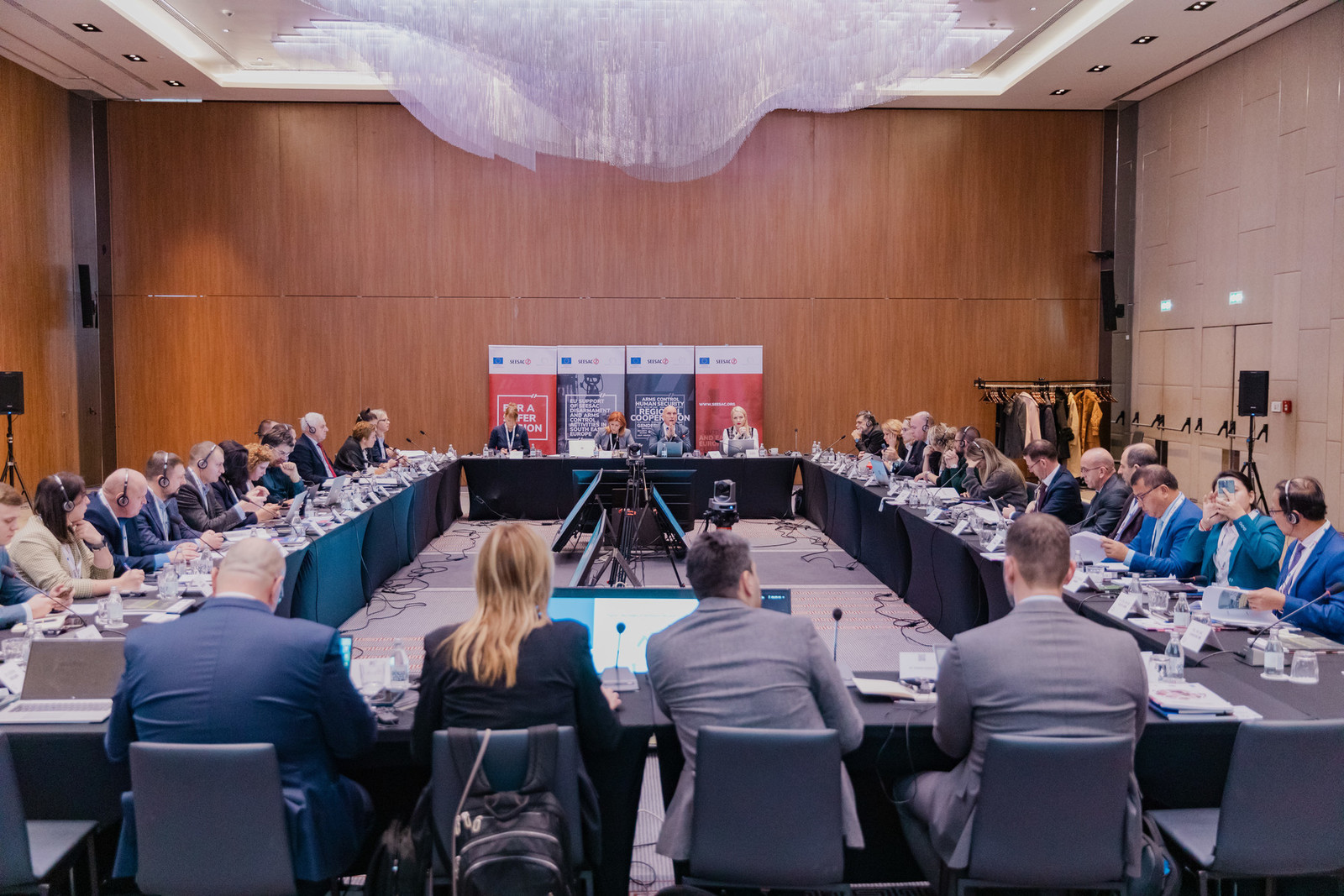
As part of implementation of this project, eight Regional Meetings of SALW Commissions in Southeast and Eastern Europe were organized throughout the region, provided the much-needed forum for institutions from the Western Balkans, Republic of Moldova and Ukraine to discuss challenges, learn from each other and further strengthen their capacities for formulation and implementation of arms control policies. These meetings intensified collaboration and joint work of the SALW Commissions, turning this process into a unique and sound model of knowledge sharing, regional cooperation and confidence building; they also facilitated knowledge exchange and information sharing with relevant authorities in Ukraine.
To learn more about these meetings, see the following:
- 13th SALW Commissions meeting 13-14 April 2021, hybrid setting
- 14th SALW Commissions meeting, 12-13 October 2021, hybrid setting
- 15th SALW Commissions meeting, 7 July 2022, Skopje
- 16th SALW Commissions meeting, 15 December 2022, Budva
- 17th SALW Commissions meeting, 6 July 2023, Sarajevo
- 18th SALW Commissions meeting, 21 December 2023, Tirana
- 19th SALW Commissions meeting, 11 July 2024, Podgorica
- 20th SALW Commissions meeting, 12 December 2024
Technical and Advisory Support to SALW Commissions
Through the project, further support was provided to SALW Commissions through the provision of technical and advisory support to enhance policy development and implementation. In this context, support has been provided for data collection and analysis, development of SALW control policies and action plans and mainstreaming gender perspective in policymaking.
SEESAC supported the SALW Commissions in Albania, Kosovo1 and North Macedonia, the SALW Coordination Board in Bosnia and Herzegovina and SALW Coordination Council in Serbia, in the processes of evaluating current strategies and revising or drafting new SALW Control Strategies and Action Plans. Action Plan in Albania and SALW Strategies and Action Plans in Kosovo and North Macedonia were subsequently adopted.
Support to SALW Commissions continued also through the provision of English language courses, which were initiated for senior members of SALW Commissions and relevant institutions in North Macedonia, Montenegro, Bosnia and Herzegovina and the Republic of Moldova to strengthen their knowledge. Forty-one participants attended English language courses, of which 34 completed 61 courses across various levels, ranging from the beginner to the proficient. Supporting English language courses for senior members of SALW Commissions across the region improved their communication skills, thus enhancing cooperation and facilitating the exchange of information and knowledge among representatives across jurisdictions both at policy-making and operational level.
Strengthening Data Collection, Analysis and Transparency
SEESAC supported authorities in strengthening their capacities for data collection and analysis. In Bosnia and Herzegovina, relevant IT equipment was provided to the Ministry of Security in response to their request for creating capacity for more efficient data collection and analysis. Additionally, the Ministry of Internal and Foreign Trade of Serbia received support in upgrading its software for record-keeping and reporting on arms transfers. Additionally, SEESAC supported the General Police Inspectorate of the Republic of Moldova in establishing an electronic Weapons Registry System with nationwide access. The digital weapons registry was officially launched in September 2022. Additionally, to assess the way forward, a needs assessment visit was conducted in 2023 to determine the needs for further enhancing the weapons registry system. Preparatory work for a Feasibility Study for the second phase of the Weapons Registry in the Republic of Moldova was initiated. In addition, procurement of IT equipment to further support the enhancement of data collection and analysis capabilities of the Moldovan Criminal Police was completed and 42 laptops and laser printers were delivered in 2024.
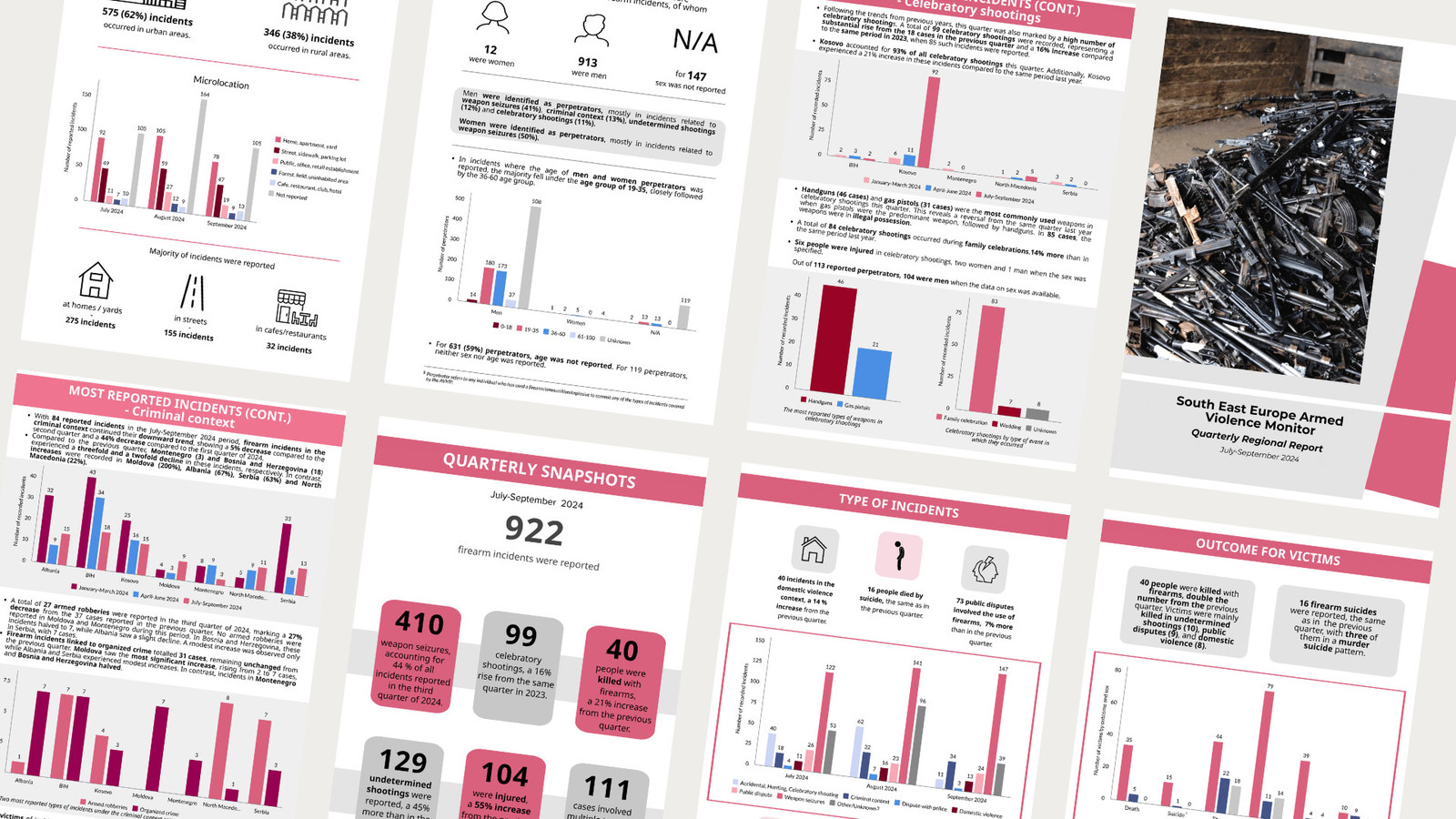
Targeted and on-demand policy-relevant research has been conducted and relevant knowledge products produced. With the aim of further expanding the knowledge base on misuse of firearms in the region, SEESAC continued facilitating the Armed Violence Monitoring Platform by regularly updating it with information on firearms-related incidents. Drawing from the data collected, 16 monthly monitors, 17 quarterly monitors, and 20 In Focus monitors were shared and published on SEESAC’s website during the reporting period. Upon request, SEESAC delivered AVMP-based data analysis to various stakeholders.
With the aim of providing snapshots of key data and trends based on the SALW Survey Reports, seven Fast Facts on Small Arms and Light Weapons Survey were published in 2020.
Four regional Arms Export Reports were published for 2018, 2019, 2020, and 2021, based on data for Albania, Bosnia and Herzegovina, Montenegro, North Macedonia, and Serbia, contributing to transparency of arms exports from the region. These reports closely follow the example set by the European Union, which publishes the only other regional report on arms exports, demonstrating thus high level of transparency.
Additionally, a Study on hand grenades produced in the Western Balkans or originating from the Western Balkans, alongside a Best Practices Manual, were developed.
Regional Meetings of South-East Europe Firearms Experts Network
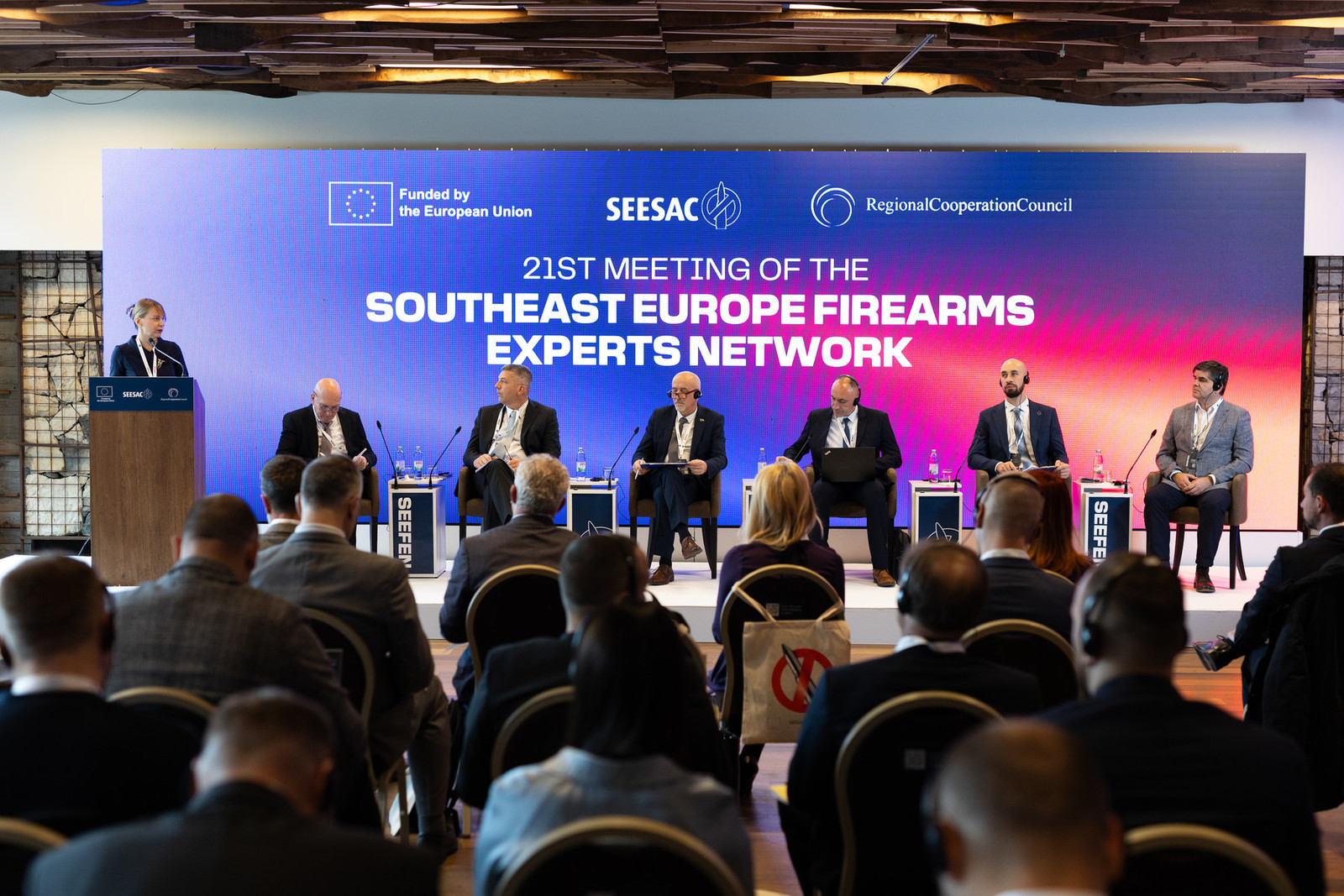
Regional cooperation on combating arms trafficking was facilitated though the key regional platform addressing the combating illicit arms trafficking in South East and East Europe at the operational level, the South-East Europe Firearms Experts Network (SEEFEN). Nine SEEFEN meetings were convened throughout the reporting period, contributing to increased operational cooperation and the exchange of information among law enforcement in Southeast and Eastern Europe, as well as with EU specialized agencies. The SEEFEN network gathers biannually representatives from criminal police, ballistic units, customs administrations, border police, and prosecution offices from the Western Balkans, the Republic of Moldova, and Ukraine to share best practices, trends, and concrete cases of cross-border cooperation in countering the trafficking of firearms. Representatives of EUROPOL, FRONTEX, INTERPOL and other police services are regularly taking part. Furthermore, technical advice and expertise were also provided to SEEFEN members upon request.
To learn more about these meetings, see the following:
- 13th SEEFEN meeting, 17-18 November 2020, hybrid setting
- 14th SEEFEN meeting, 1-2 June 2021, hybrid setting
- 15th SEEFEN meeting, 26-27 October 2021, hybrid setting
- 16th SEEFEN meeting 31 May-1June 2022, Tirana
- 17th SEEFEN, 1-2 November 2022, Skopje
- 18th SEEFEN meeting, 13-14 June, 2023, Sarajevo
- 19th SEEFEN meeting, 7-8 November 2023, Budva
- 20th SEEFEN meeting, 14-15 May 2024, Tirana
- 21st SEEFEN meeting, 19-20 November 2024, Jahorina
Harmonisation of SALW and Explosives Legislation with the EU Acquis
Technical and advisory support was provided to all 6 Western Balkans jurisdictions in harmonizing their SALW and explosive control legislation with the relevant EU acquis through the development of gap analysis and organization of thematic workshops and provision of expertise on legislative and policy updates in the area of firearms and civil use of explosives.
SEESAC proceeded with the provision of on-demand support for the harmonization of arms control legislation for relevant amendments in line with the EU legislation on arms control and standardization.
SEESAC provided support to the authorities in Kosovo[1], Montenegro and North Macedonia in the process of amending their Laws on Explosives for Civil Use, as well as to Bosnia and Herzegovina, Albania, North Macedonia, Montenegro and Serbia in harmonizing their Laws on weapons with the EU acquis by providing technical advice, development of tables of concordance, gap analysis and by organizing dedicated workshops. Furthermore, two Regional Workshops on the Harmonisation of Legislation Related to Arms Control were organized jointly with EEAS and DG HOME in Brussels, Belgium in 2023 and 2024, for the authorities coming from the Western Balkans, the Republic of Moldova, and Ukraine with the aim to contribute to standardization of legal provisions in different Laws and practices throughout SEE and with the EU.
In further support to harmonization of arms control legislation and its practical implementation, including provisions on voluntary surrender and firearms legalization across the Western Balkans, SEESAC developed Emergency Protocols detailing procedures for safely transporting small quantities of ammunition and explosives for final destruction. Protocols were translated into local languages and shared with relevant institutions of all 6 Western Balkan jurisdictions, Republic of Moldova and Ukraine.
Gender-Responsive SALW Control
To further support the integration of gender perspective in SALW control policy‐making; SEESAC published in June 2024 on its website The Gender and SALW Control Resource Pack, which provides a concise overview of the wide range of knowledge products developed by SEESAC as part of other projects and serves as a simple reference guide and aid to policy-makers, practitioners, and researchers. The Advanced Regional Gender and SALW Training was organized by SEESAC in Montenegro in October 2024 for nineteen representatives of SALW Commissions and gender equality agencies from the region to further strengthen the institutional capacities for gender-responsive SALW control policymaking.
SEESAC also provided substantial support to the SALW Coordination Board in Bosnia and Herzegovina for a campaign against femicide in 2024, as well as through a review of the Gender Action Plan for Bosnia and Herzegovina related to measures to mainstream gender in SALW control.
Transfer of Regional Expertise and Global Knowledge Exchange
In cooperation with UNODA, SEESAC supported the transfer of acquired knowledge through delivery of tailor-made coaching programmes on gender mainstreaming in small arms to United Nations Regional Centre for Peace and Disarmament in Asia and the Pacific (UNRCPD), United Nations Regional Centre for Peace and Disarmament in Africa (UNREC), and United Nations Regional Centre for Peace, Disarmament and Development in Latin America and the Caribbean (UNLIREC) staff.
Finally to further facilitate knowledge exchange, SEESAC developed the policy brief Small Arms Control – The Case for Gender Mainstreaming. The brief summarizes the overall approach to gender mainstreaming in SALW control in South East Europe and outlines practical strategies in enhancing the gender responsiveness of arms control.
Continuing its long-standing practice of transferring SEE-acquired expertise to other regions and to contribute to coordination of efforts on SALW control among different stakeholders, SEESAC regularly contributed to the meetings of the UNODA-led Informal Coordination Mechanism on Gender and SALW; the coordination calls among UN agencies on Weapons and Ammunition Management; and the coordination meetings of international partners in support in SALW control efforts in Ukraine organized by OSCE. In addition, SEESAC delivered presentations sharing the lessons learnt from Southeast and Eastern Europe during several international meetings organised by partners. Transfer of SEE-acquired expertise to other regions was facilitated though numerous meetings, coaching and knowledge products – most notable among those resulting in the replication of SEESAC’s Armed Violence Monitoring Platform in the EU.
These activities complemented a more comprehensive support for mainstreaming gender in SALW control implemented as part of other projects in SEESAC’s portfolio.