
SEESAC Presents its Activities at the Consultative Meeting on Safe and Secure Management of Conventional Ammunition in Geneva
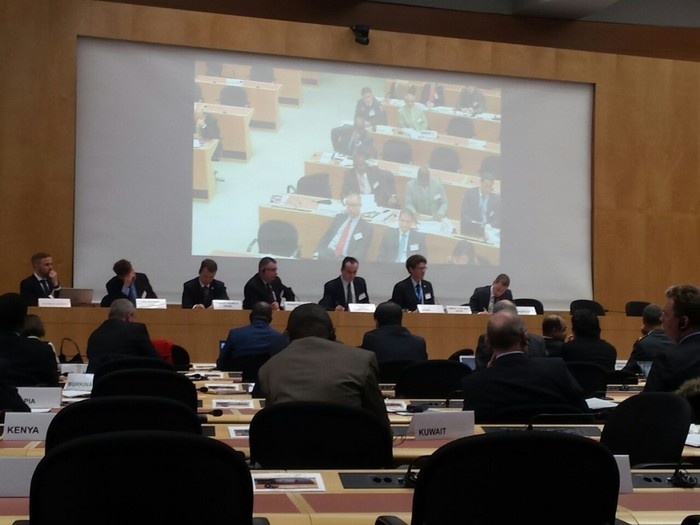
Geneva - SEESAC participated in the Consultative Meeting on Safe and Secure Management of Conventional Ammunition on 16-17 November 2015, organized by the Swiss Federal Department of Foreign Affairs. With the aim to coordinate its efforts with other actors in this field, SEESAC shared information about its activities implemented in the area of arms control and conventional ammunition as well as future plans.
The goal of the meeting was to initiate a discussion on establishing a common understanding of the safe and secure management of conventional ammunition and provide a platform for multilateral and open discussions among the representatives of states, international and non-governmental organizations, as well as other experts.
SEESAC presented the Regional Micro-Disarmament Standards and Guidelines (RMDS/G), national and regional courses on Physical Security and Stockpile Management, as well as about two of its projects aimed at lessening the proliferation of SALW and its ammunition in South East Europe through secure interventions – the EUSAC and CASM projects.
EUSAC:
SEESAC provides support to national and regional stakeholders in strengthening their capacities to control and reduce the proliferation and misuse of small arms and light weapons and in this way contribute to stability, security and development in South East Europe (SEE). European Union supports SEESAC’s disarmament and arms control activities in SEE through the Council Decision 2013/730/CFSP, from 9 December 2013.
EUSAC builds directly upon SEESAC’s decade-long SALW Control work, particularly achievements made through the previous EU funded SALW Control project, conducted during the 2010-2012 period under the Council Decision 2010/179/CFSP. Designed in close cooperation with national authorities, the project works on the following five interrelated streams of activities:
- Increased security of stockpiles: through the renovation and security improvements to storages of arms and ammunition.
- Stockpile reduction: through the destruction of surplus arms and ammunition held in storages.
- Improved marking, tracing and registration of SALW: through the provision of support to the establishment or enhancement of existing weapons registration and record-keeping systems.
- Improved regional cooperation on awareness raising, information sharing and knowledge transfer: through the facilitation of regional cooperation between national institutions tasked with arms control.
- Implementation of collection and awareness raising campaigns
CASM
SEESAC’s Capacity Development Programme for Conventional Ammunition Stockpile Management for the Republic of Serbia (CASM) Project came as a response to a specific need, expressed by the Ministry of Defence of the Republic of Serbia, to improve the MoD's capacity for conventional ammunition stockpile management by enhancing the security
and safety of particular conventional ammunition storage locations, disposing of surplus ammunition and strengthening demilitarization capacities of the MoD.
CASM’s key goals are improved human security through the upgrade of safety and security of ammunition storage sites; enhanced counter-proliferation through reduced quantity and enhanced security of surplus stockpiles and improved demilitarization capacities with the upgrade of TRZ Kragujevac infrastructure. The project has three distinct components:
- Demilitarization and Disposal of approximately 1,133 tons of white phosphorus and napalm powder filled ammunition;
- Infrastructure Development of ammunition storage areas and capacity development of ammunition management system at Mrsac and Mirnicka Reka;
- Infrastructure Improvement of the demilitarization facility - TRZ Kragujevac.