
UN Secretary-General’s Report Highlights UNDP SEESAC’s Role in Regional Arms Control
The latest report of the United Nations Secretary-General on small arms and light weapons (SALW) underlines the continued scale and complexity of illicit arms flows worldwide, while emphasizing the importance of sustained investment in addressing it. Issued ahead of the Ninth Biennial Meeting of States on the Programme of Action on SALW (BMS9), the report reviews global policy developments and operational activities in SALW control undertaken between June 2025 and February 2026.
The illicit misuse of SALW continues to affect peace, security, development and human rights, while emerging technologies, such as 3D printing, are making marking, tracing and record-keeping increasingly complex. The report notes that, although efforts by Member States, the United Nations and other partners remain productive, the scale and evolving nature of the challenge require intensified and continued efforts.
Against this broader global context, the Western Balkans SALW Control Roadmap is presented as an important example of a structured regional mechanism. The report highlights that the Roadmap continued to advance sustainable arms control and alignment with EU and international frameworks, with UNDP SEESAC serving as coordinator of the process. It also notes that in 2025, the Western Balkans SALW Control Roadmap Multi-Partner Trust Fund where UNDP SEESAC serves as the secretariat, received USD 1.86 million in new contributions, bringing its overall value to USD 31 million and extending its duration until 31 December 2028.
Through this mechanism, nine projects were supported in cooperation with authorities in the Western Balkans, contributing to Roadmap goals, including legislative alignment, infrastructure upgrades, gender-responsive operations, improved crime scene investigations and community outreach on firearm misuse.
The report also recognizes UNDP SEESAC’s role in sustaining regional cooperation through platforms such as the Regional Meeting of SALW Commissions and the South East Europe Firearms Experts Network. These mechanisms support regular policy and operational exchanges among representatives of the Western Balkans, the Republic of Moldova and Ukraine, strengthening transparency, accountability and peer learning.
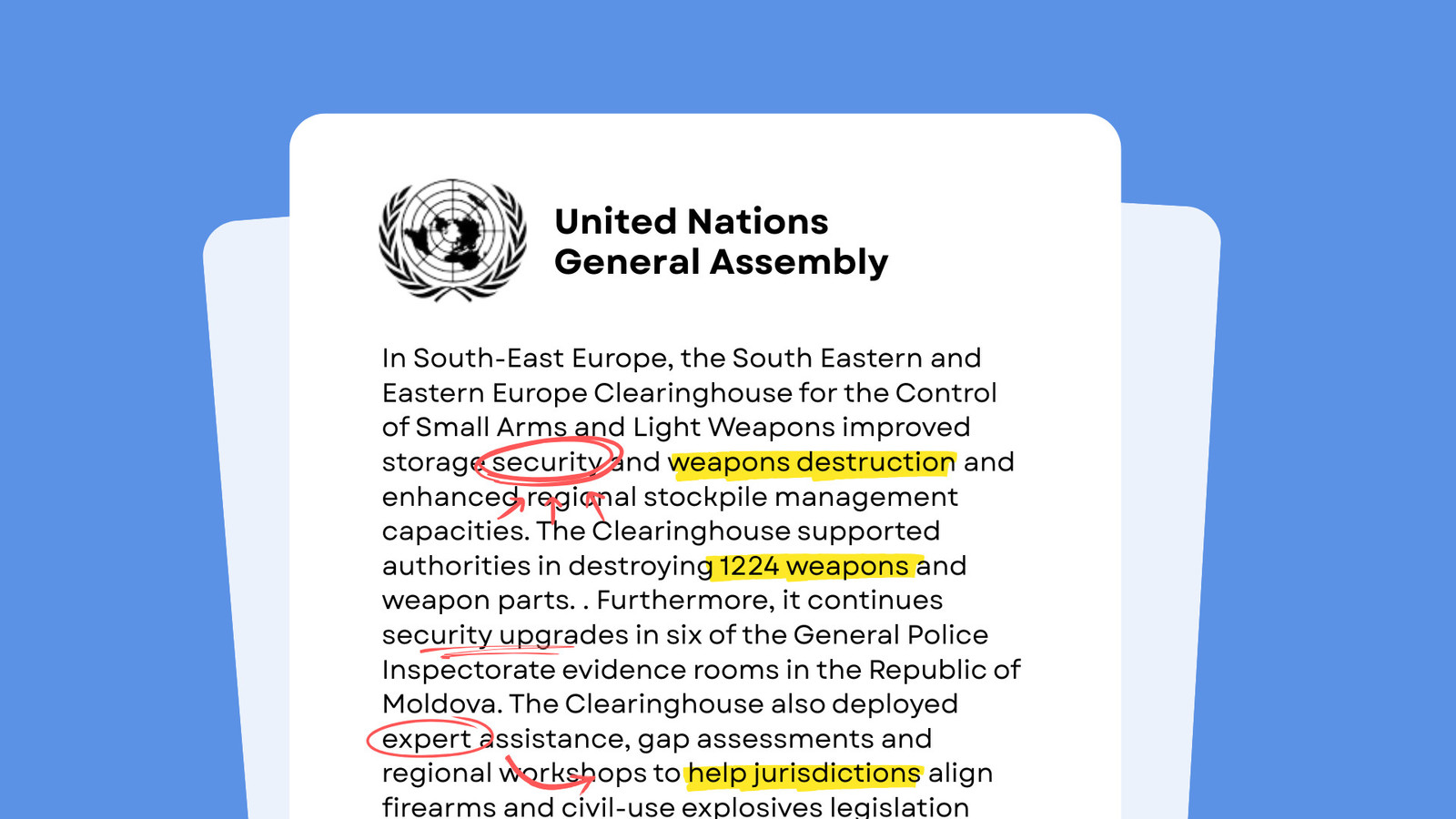
The report further highlights UNDP SEESAC’s contribution to arms control and prevention through evidence-based analysis, awareness-raising, weapons and ammunition management, including physical security and weapons destruction, support to investigations of firearm-related crimes and gender-responsive arms control. Beyond the region, UNDP SEESAC’s work is also noted for contributing to interregional cooperation and the transfer of small arms control practices, including through exchanges with partners in Latin America and South-East Asia.
As the international community prepares for BMS9, the report underscores the need for practical, coordinated and well-resourced responses to illicit SALW flows. UNDP SEESAC’s work in South-East Europe reflects this approach, showing how sustained regional cooperation, evidence-based action and strong partnerships can help translate commitments into concrete results.