
[JUST PUBLISHED]: Regional Analysis on Women in SALW Control in the Western Balkans
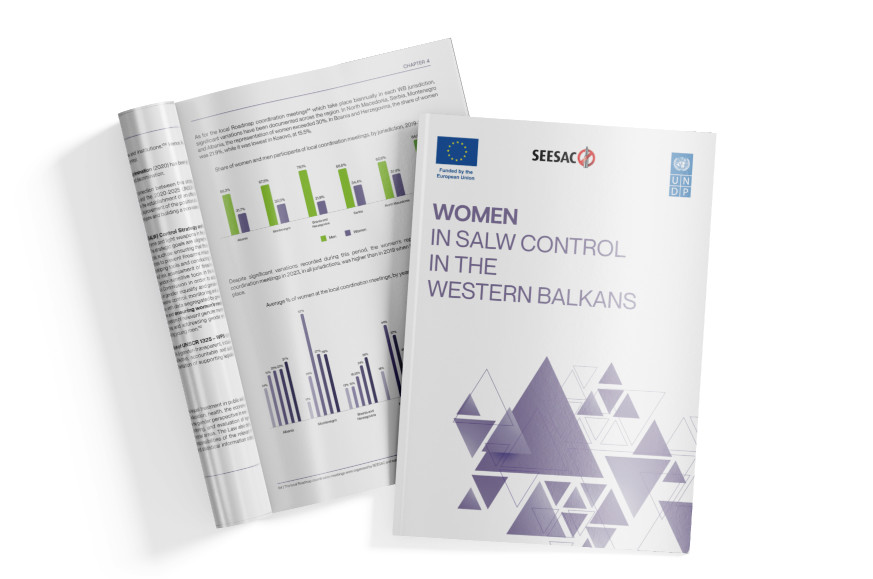
SEESAC has published a comprehensive Regional Analysis on Women in Small Arms and Light Weapons (SALW) Control in the Western Balkans, providing fresh insights into women’s role in this field, their contributions, and challenges to gender-balanced participation in SALW control.
The significance of women's full and effective participation in the security sector, including SALW control, has gained global recognition as an essential element in promoting lasting peace, security, and gender equality.
Similarly, the Western Balkans has seen significant progress in developing legal and policy frameworks for enhancing gender equality and preventing discrimination, creating a solid foundation for women’s effective participation in SALW control. The Western Balkans (WB) SALW Control Roadmap, along with jurisdictional SALW control strategies, emphasize the integration of a gender perspective and prioritize women’s involvement in this domain.
To assist the WB jurisdictions in meeting their obligations arising from international, regional, and jurisdictional legal and policy frameworks, SEESAC conducted an analysis of women’s professional engagement in SALW control throughout the region. Based on extensive desk research and in-depth interviews with women and men involved in this field, the analysis explores key trends and main challenges, offering an inventory of evidence-based measures to contribute to a more balanced representation and effective participation of women in SALW control.
An excerpt of the key findings:
The analysis has documented several key trends demonstrating progress in women's representation, particularly in policy-related areas:
- Women's representation in SALW commissions (The central coordination and monitoring inter-institutional bodies on SALW Control) has risen substantially in recent years, with some jurisdictions surpassing 40% by 2022 — a significant improvement from 2016, when representation ranged between 14% and 29%.
- Women account for an average of 31% of participants in regional meetings monitoring the SALW Control Roadmap, showcasing steady progress from 17.3% in 2019 to 42.3% in 2022.
- In addition, women had a significant role in legislative reforms, making up 54.9% of participants in regional workshops focused on harmonizing SALW control legislation with the EU acquis.
Still, the analysis highlights the persistent underrepresentation of women in operational and technical areas, with the share of women ranging from 8.5% to 9.6% border police services, and 11% to 29.5% in the criminal police. This disparity is particularly pronounced in the field of physical security and stockpile management, where some jurisdictions reported cases of no women being engaged at all.
The insufficient representation of women in these roles underscores the impact of societal norms and gender specific barriers. In-depth interviews with practitioners in SALW control, both women and men, documented persistent challenges faced by women, such as:
- Perceptions that frame small arms control as a male domain, discouraging women from entering technical and operational sectors. Societal expectations and traditional gender roles play a significant role in shaping women’s career choices. Women often opt out of operational roles in SALW control due to deeply ingrained societal expectations and personal preferences influenced by cultural norms.
- Systemic gendered division of roles, with women often directed toward administrative roles, while men prevail in operational tasks and technical positions that have historically been dominated by them.
- Even with legal frameworks supporting gender equality, societal perceptions can undermine their implementation and effectiveness.
- Educational trajectories with qualifications that have traditionally seen fewer female graduates.
- Work-life balance were women frequently face the dual burden of professional and family responsibilities, which hinders their career progression. This dual burden often leads them to seek other professional roles or leave the profession entirely, perpetuating their underrepresentation in critical operational tasks.
To overcome these systemic challenges and foster an inclusive, gender-equitable environment in SALW control, a comprehensive set of measures is proposed for institutions in charge of SALW control, including:
- Fostering enabling and gender-inclusive environments and providing equal opportunities, including education and qualifications,
- Improving record keeping and application of gender analysis by the human resources departments,
- Implementing targeted recruitment strategies,
- Capacity building and technical training for women,
- Awareness-raising campaigns,
- Strengthening leadership and decision-making opportunities,
- Promoting flexible work arrangements and family-friendly policies,
- Strengthening gender equality mechanisms and mechanisms against harassment and discrimination,
- Continuous monitoring and evaluation,
- Using gender budgeting to enhance the sustainability of such measures.
The analysis is also available in Albanian, BCMS, and Macedonian languages.
The regional analysis was conducted under the regional project 'Support for Enhancing the Fight Against the Illegal Possession, Misuse, and Trafficking of Small Arms and Light Weapons (SALW) in the Western Balkans' funded by the European Commission, Directorate-General for Neighborhood and Enlargement Negotiations, through the Instrument for Pre-accession Assistance (IPA II). Through this project, SEESAC is providing among other support to authorities in the Western Balkans to mainstream the gender perspective in the SALW control measures and in their efforts to ensure full and meaningful participation of women in SALW control.