
UN Secretary-General’s Reports Highlight Southeast Europe’s Progress on Arms Control through Regional Cooperation
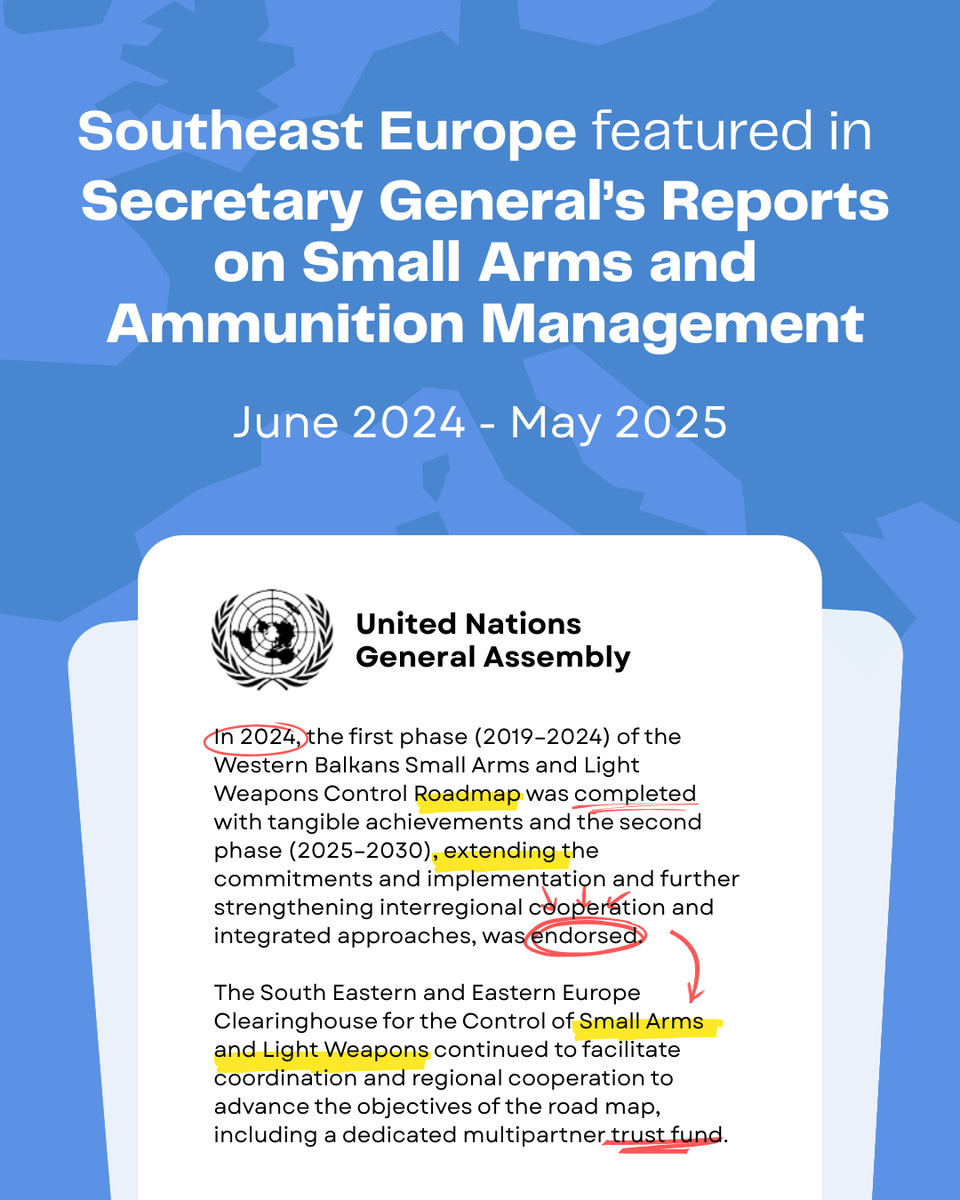
The United Nations Secretary-General released three reports in 2025 underscoring global progress in decreasing the illicit trade of small arms and light weapons (SALW) and advancing sustainable approaches to conventional ammunition management. The three documents emphasize the importance of regional cooperation, effective assistance mechanisms, and innovative responses to emerging threats.
The report released in June, Assistance to States for curbing the illicit traffic in small arms and light weapons and collecting them and the illicit trade in small arms and light weapons in all its aspects (A/80/111), prepared in response to General Assembly resolutions 79/40 and 79/31, reviews global policy developments and multilateral initiatives between June 2024 and May 2025. It emphasizes the role of disarmament in preventing armed violence, supporting sustainable development, and strengthening gender-responsive arms control placing particular attention on the Western Balkans as a model of effective regional cooperation and tangible achievements. The second phase (2025–2030) of the Roadmap for a sustainable solution to the illegal possession, misuse and trafficking of small arms and light weapons, their ammunition and explosives in the Western Balkans extends the commitments and implementation and further strengthens interregional cooperation and integrated approaches. The Report recognized UNDP South Eastern and Eastern Europe Clearinghouse for the Control of Small Arms and Light Weapons (SEESAC) key role in fostering coordination and regional cooperation to advance the objectives of the Roadmap. It showcases SEESAC’s response to emerging threats such as 3D-printed firearms, including the publication of a study for law enforcement, as well as the concrete efforts in integrating gender perspective into arms-control policies, such as the Guidelines on gender-responsive firearm licence approval and the Guidelines for assessing and addressing risks related to firearms misuse in domestic violence cases.
In July, the Secretary-General released Through-life Conventional Ammunition Management (A/80/238) report pursuant to General Assembly resolution 79/54. This report takes stock of early implementation of the Global Framework for Through-life Conventional Ammunition Management adopted in December 2023. Referencing activities in South-Eastern Europe, the report illustrates how sustainable life-cycle management of ammunition is being advanced alongside SALW control measures, highlighting the need to address both arms and ammunition to effectively reinforce regional stability and ensure long-term security. It includes information that the Western Balkans endorsed the second phase of implementation of the Western Balkans Roadmap which contains concrete commitments concerning functional areas of arms control, including physical security and stockpile management of ammunition. Similarly, the report emphasizes that SEESAC continued to strengthen physical security and stockpile management across the Western Balkans and strengthen arms, ammunition and explosives control by supporting policy development and capacity-building and by facilitating 11 regional meetings aimed at strengthening cross-border cooperation on countering trafficking in arms and ammunition. It underlined that in the effort to strengthen gender-responsive arms control, in the Western Balkans guidelines were developed on the risks related to firearm and ammunition misuse in domestic violence, complemented by a training-of-trainers programme.
The Small arms and light weapons Report of the Secretary-General, released in October 2025, reiterated that the Western Balkans Roadmap, adopted in 2018 and facilitated by SEESAC, continued to be a sustainable regional approach for preventing and countering the misuse, illegal possession and trafficking of firearms, ammunition and explosives. In the Western Balkans, 4,984 firearms were seized inland and at the borders in 2024,with the support of SEESAC, which supports authorities in the South East Europe to make advances in the physical security and stockpile management of small arms and light weapons and ammunition, including the destruction of more than 2,000 weapons in the reporting period. This report, as the previous two SG’s reports on SALW control released in 2025, underlined the importance of the Western Balkans Roadmap, reminding that the Roadmap second phase was endorsed at the European Union-Western Balkans Ministerial Forum on Justice and Home Affairs in October 2024, which reconfirmed the emphasis on institutional sustainability, a whole-of-government and -society approach, gender mainstreaming and youth inclusion, effective response to threats, and alignment with European Union regulatory frameworks. Furthermore, the report emphasized the importance of cross-regional exchanges of practices of the regional and subregional models mentioning that during the reporting period, study visits by Cambodia, Honduras and Kyrgyzstan with support of SEESAC to the Western Balkans allowed for such exchanges.