
[JUST PUBLISHED]: The Regional Analysis on the Misuse of Firearms in Domestic Violence in the Western Balkans
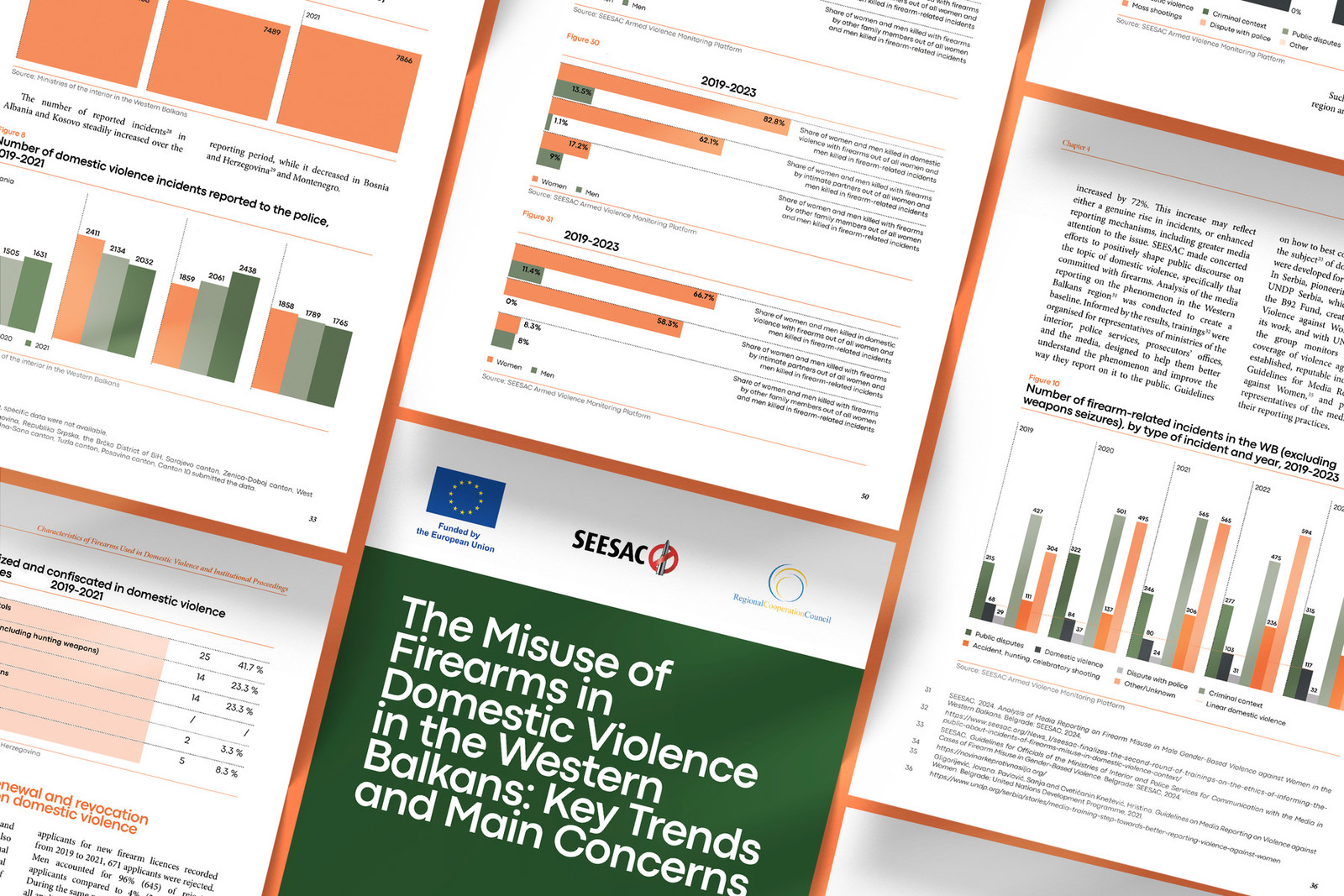
SEESAC has published a Regional Analysis on the Misuse of Firearms in Domestic Violence in the Western Balkans: Key Trends and Main Concerns, which offers comprehensive insights into the impact of firearms in domestic violence and highlights its gender-based nature.
The analysis aims to contribute to enhanced prevention of firearms misuse in domestic violence and improved safety of women, men, girls, and boys in the Western Balkans. It extensively documents the disproportionate impact on women and the varying risk patterns faced by women and men. The analysis also tracks critical trends, identifies challenges in prevention, gaps in institutional responses, and offers evidence-based recommendations to improve prevention and protection systems in the region. A robust mixed-methods approach was employed, combining quantitative data from the Armed Violence Monitoring Platform (AVMP) and the Ministries of the Interior in the Western Balkans, with qualitative insights gathered from 15 focus group discussions held across the region, with police officers working on domestic violence cases, officers responsible for firearms licensing, and representatives from women's organisations providing support to victims of domestic violence.
The findings highlight the far-reaching and detrimental impacts of firearms misuse in the domestic context in the region and reveal persistent trends and complex risks they introduce.
An excerpt of the key findings:
- Women and men experience firearm victimisation differently, with women nearly five times more likely to encounter firearm misuse in domestic violence (29.8% vs. 6.2%). From 2019 to 2023, women represented 62.8% of domestic firearms victims, while men accounted for 37.2%.
- Women are particularly affected by firearm-related intimate partner violence, constituting 97.7% of such victims, thus highlighting its gender-based nature. Men, however, are more often victimised by male family members in domestic violence contexts.
- Firearms misuse in domestic violence is highly lethal - 152 deaths (93 women and 59 men) - exceeding incidents in criminal contexts (144) and public disputes (135).
- The disproportionate impact of firearms misuse in domestic violence on women is particularly evident in the breakdown of firearm fatalities by incident type - 68.4% of women killed with firearms were killed in a domestic violence context, while 10.9% of men killed with firearms were killed by their family members. Every second woman (50.7%) killed with a firearm was killed by their current or former intimate partner, compared to 0.6% of men.
- Perpetrators are overwhelmingly men (98.1%), most frequently aged 36-60, followed by 19-35 age group.
- Within the context of firearms misuse in domestic violence, femicide-suicides and murder-suicides are frequent phenomena. According to the AVMP, from 2019 to 2023, a total of 51 such incidents were recorded. 52.2% of murder suicides occurred in the context of intimate partner violence.
- Although firearm-related domestic violence accounts for only 3.1% of reported firearm incidents due to underreporting and record-keeping issues, the high fatality rate emphasises the heightened risks and lethal outcomes associated with firearms in these cases.
- The use of firearms for threats, coercion, or other forms of gender-based violence remains underreported, despite being common precursors to fatal events. Over five years, 177 firearm-related threats in the domestic violence context were recorded, with 67.2% involving intimate partners.
- Handguns are the most commonly used firearms in domestic violence. Illegally owned firearms are reported more often than legal ones.
Focus group discussions provided a more nuanced understanding of how firearms impact victims of domestic violence, capturing aspects often missed by quantitative data:
- Firearms are tools of coercion and control, reinforcing power imbalances and gender hierarchies and heightening victims' fear. This reduces the likelihood of reporting abuse with victims, especially women, often withholding reports due to fears of escalation of violence and retaliation.
- Women typically report violence only when they feel their lives or the lives of their children are in imminent danger. Additionally, cultural norms and gender hierarchies tied to firearms as symbols of male identity deter reporting by victims and the community.
- Firearms reduce the victims' capacity for resistance to violent behaviours. Firearms, as well as explosives, are used to reassert control over a victim. Its presence also increases women's fear of sexual violence.
Focus group discussions also documented progress achieved as well as remaining challenges in the institutional response to firearms misuse in domestic violence, particularly in risk assessments and practices related to firearms license approval, which need to fully take into account the specifics of risks firearms pose in the domestic context.
Recommendations
Building on the key findings, analysis also offers strategic recommendations, emphasising the necessity of coordinating SALW control and domestic violence prevention frameworks as a critical precondition for preventing firearms misuse in domestic violence and gender-based violence generally, including:
- Mitigating firearms misuse in the domestic violence context – raising awareness and reducing the proliferation and circulation of firearms in illegal possession
- Enhancing risk assessments and strengthening operational response
- Enhancing procedures for firearms licence approval for civilians
- Improving data and monitoring systems
- Providing capacity building and enhancing a victim-centred and intersectional approach
- Maintaining and strengthening further regional cooperation and knowledge sharing
The analysis is also available in Albanian, BCMS, and Macedonian languages.
The regional analysis was conducted under the regional project 'Support for Enhancing the Fight Against the Illegal Possession, Misuse, and Trafficking of Small Arms and Light Weapons (SALW) in the Western Balkans' funded by the European Commission, Directorate-General for Neighbourhood and Enlargement Negotiations, through the Instrument for Pre-accession Assistance (IPA II). Through this project, SEESAC is providing support to authorities in the Western Balkans to mainstream the gender
perspective in the SALW control measures and, in particular, to prevent and combat the misuse of firearms in domestic violence.