
Certificates awarded to Experts from BiH Ministry of Security and Police Services after successfully completing PSSM Training

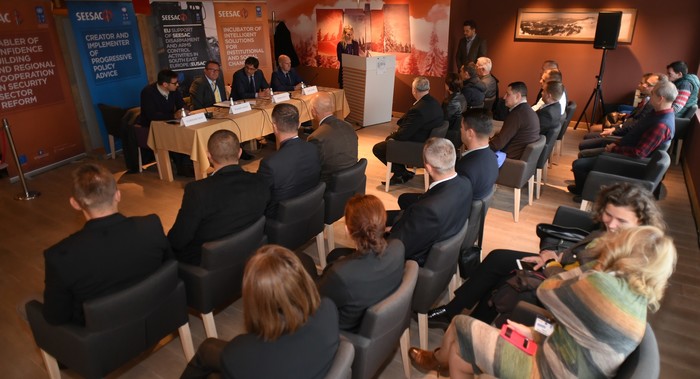
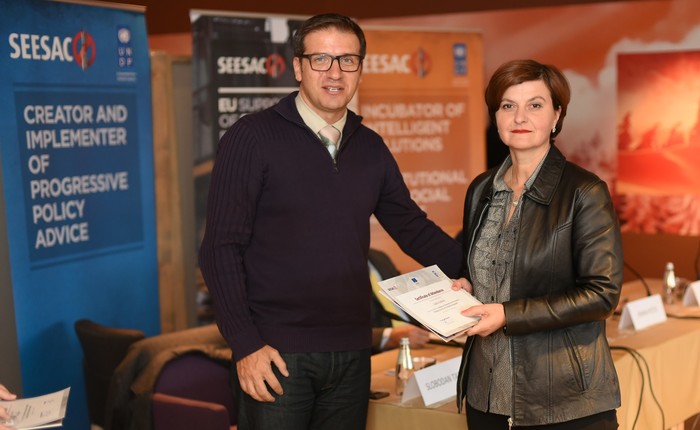
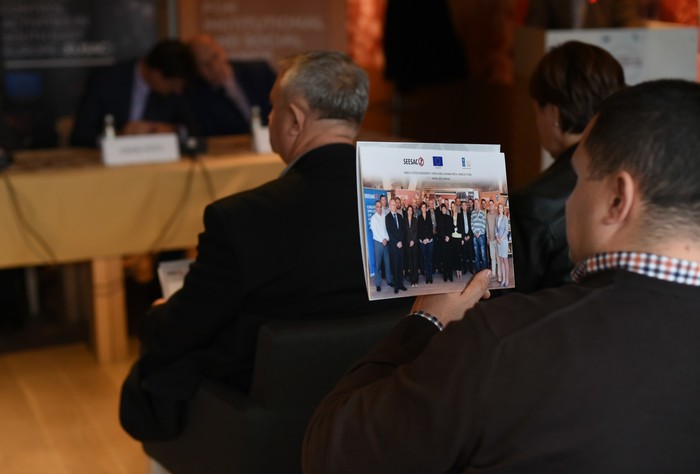
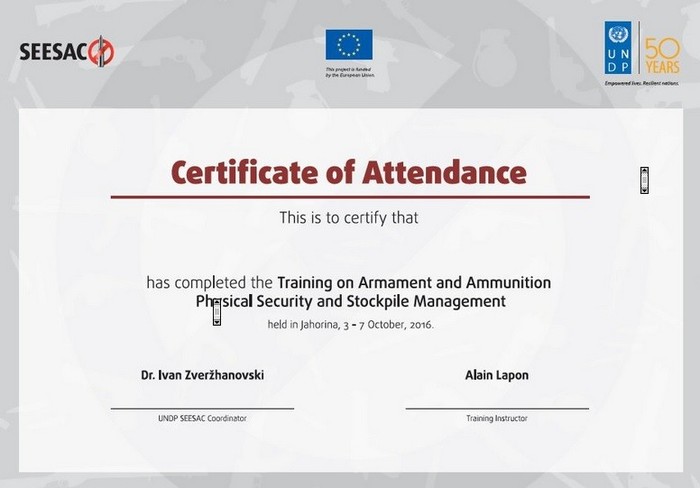
Certificates were awarded on 7 October 2016 to 20 participants from the Ministry of Security and police agencies in Bosnia and Herzegovina (BiH) who successfully completed a week long training in Armament and Ammunition Physical Security and Stockpile Management (PSSM), funded by the European Union (EU).
Mr. Ermin Pešto, Assistant to Minister of Security of Bosnia and Herzegovina addressed the participants during the certification ceremony and said: “We are delighted to know that during this course, participants from the police services and Ministry of Security BiH, aside of national procedures, had an opportunity to get familiar with the standards and procedures of physical security and stockpile management in accordance to ISACS 5.20 and other relevant UN documents with regards to SALW.“
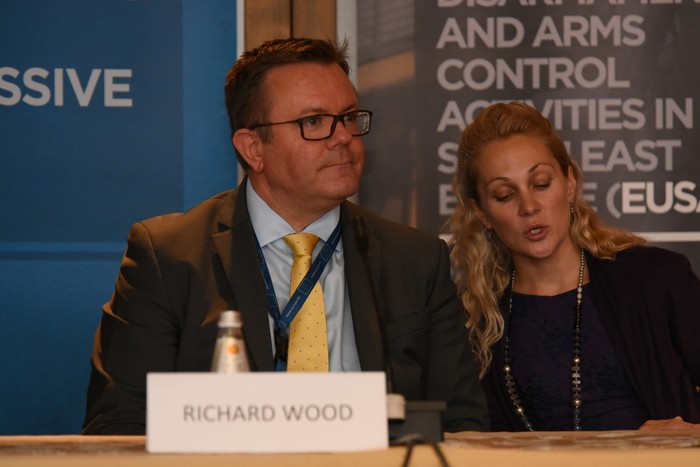
In addition, Mr. Richard Wood, Senior Advisor and Head of Rule of Law Section at Delegation of European Union to Bosnia and Herzegovina highlighted that: “I am very confident that this new specialized knowledge and the skills you have obtained during the course, will help you to perform your regular jobs on daily basis in more effective manner. It will certainly contribute to the overall achievements of your agencies regarding the control of weapons and ammunition“.
“The course that you successfully completed today, is another contribution towards efficient arms control by enhancing the technical capacities of the police agencies, to manage and safeguard stockpiles of small arms and light weapons (SALW) and their ammunition” Mr. Slobodan Tadic, Security and Justice Sector Leader at UNDP BiH told the participants at the ceremony.
The training held in Jahorina, was organized as part of Component 1 of SEESAC’s EUSAC project. The goal of the PSSM course was to increase capacities of personnel from the BiH Ministry of Security and police agencies in BiH – with a specific focus on the security of stockpiles. The participants received theoretical and practical knowledge on the secure storage of armament and ammunition in accordance with the International Small Arms Control Standards (ISACS). The PSSM course also complements efforts to increase security of storages through infrastructure improvements implemented under the same component of the EUSAC project.
The history of large-scale accumulation of small arms and light weapons and ammunition stockpiles in South East Europe, an insufficient number of secure storage locations, and the persistent lack of sufficient capacities to fully secure them has made the countries in the region a particular concern as well as an important challenge in the European Union Strategy to combat illicit accumulation and trafficking of small arms and light weapons (SALW) and their ammunition.
Promoting just, peaceful, and inclusive societies is one of the 17 Sustainable Development Goals (SDG) adopted by the United Nations at the Sustainable Development Summit held in New York in September last year and which the UN members have determined to achieve by 2030. This week’s training is a contribution to achievement of SDG 16, which aims to significantly reduce all forms of violence, and work with governments and communities to find lasting solutions to conflict and insecurity.
EU SUPPORT OF SEESAC DISARMAMENT AND ARMS CONTROL ACTIVITIES IN SOUTH EAST EUROPE (EUSAC)
The European Union entrusted SEESAC with the implementation of a series of region-wide activities in the period 2014 – 2016 through EU COUNCIL DECISION 2013/730/CFSP. The regional course is part of Component 1 of the resulting EUSAC Project (EU Support of SEESAC Disarmament and Arms Control Activities in South East Europe) which is an integral part of the SEESAC SALW
Control portfolio.
EUSAC marks a continuation of the trust placed in SEESAC by the EU since 2002. The Union previously supported SEESAC through Council Decision 2002/842/CFSP, extended and amended by Council Decisions 2003/807/CFSP and 2004/791/CFSP. Most recently, the Union supported SEESAC arms control activities through Council Decision 2010/179/CFSP.
Designed in close cooperation with national authorities, the EUSAC project works on the following five interrelated streams of activities:
- Increased security of stockpiles: through the renovation and security improvements to storages of arms and ammunition.
- Stockpile reduction: through the destruction of surplus arms and ammunition held in storages.
- Improved marking, tracing and registration of SALW: through the provision of support to the establishment or enhancement of existing weapons registration and record-keeping systems.
- Improved regional cooperation on awareness raising, information sharing and knowledge transfer: through the facilitation of regional cooperation between national institutions tasked with arms control.
- Implementation of collection and awareness raising campaigns.