
Annual Regional Steering Group Meeting Held
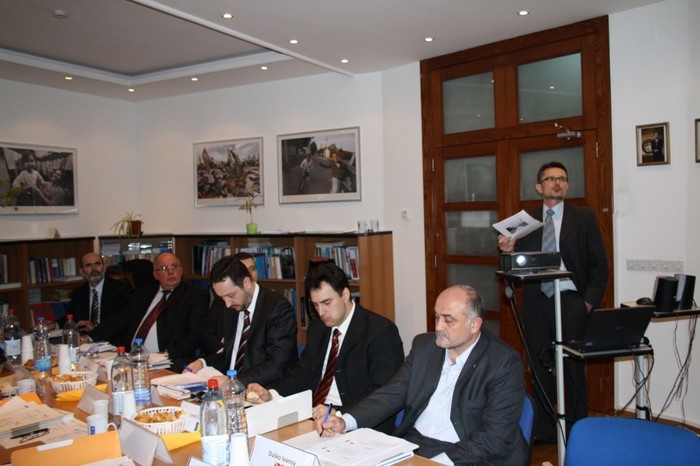
On 20 December 2011, the Regional Steering Group for Small Arms and Light Weapons (RSG) held its annual meeting in Belgrade, Serbia. Hosted by SEESAC, the meeting gathered national SALW focal points from Bosnia and Herzegovina, Bulgaria, Croatia, Romania, Serbia and the former Yugoslav Republic of Macedonia as well as representatives of the RCC, the OSCE Conflict Prevention Center and UNDP Country Offices in Croatia and Montenegro.
RSG meetings are an essential part of the SEESAC governance structure. SEESAC receives its political and strategic guidance and key indigenous support from the RSG which is composed of representatives of the governments from the states concerned, the Regional Cooperation Council (RCC), UNDP, and observers from institutions such as the European Union (EU), North Atlantic Treaty Organization (NATO), Organization for Security and
Co-operation in Europe (OSCE) and civil society.
The meeting was opened by Mr. Efrem Radev, Senior Expert for Security Issues at the Regional Cooperation Council and Dr. Ivan Zverzhanovski, SEESAC Team Leader a.i. Mr. Radev noted that SEESAC was praised by the RCC Board, which among its members counts representatives of 29 countries and various organizations, for its significant contributions and expansion of its activities into the realm of justice and home affairs.
Dr. Zverzhanovski informed the RSG about SEESAC’s activities in 2010 and 2011, as well as plans for future endeavors. He was followed by Mr. Krunoslav Katic, Project Coordinator in the Justice and Security Cluster at UNDP Croatia, with a presentation on “Security Portfolio projects in Croatia”. Mr. Gordan Ivanovic, MONDEM Programme Manager from UNDP Montenegro, updated participants on the MONDEM Programme while developments in the area of SALW and disarmament in Bosnia and Herzegovina were
briefly outlined by Dr. Zverzhanovski on behalf of UNDP BiH.
The presentations served as starting point for a subsequent discussion on challenges encountered during the implementation of the national projects, further coordination of planned activities and support for development of future SALW projects.
SEESAC activities are currently generously supported by the European Union, as an integral part of the EU Strategy to combat the illicit accumulation and trafficking of SALW and their ammunition, as well as by the Kingdom of Norway.